Meet Pip the Writer: The Agent That Builds Your AI-Citable Pages
Pip the Writer is the Vergrank agent that researches, drafts, and ships GEO-optimized pages to your site every shift — built to get cited by ChatGPT, Perplexity, Gemini, and Claude.
Pip the Writer is the Vergrank agent that builds new pages for your site — researched, drafted, and shipped to your domain every shift, each one engineered to get cited by AI answer engines like ChatGPT, Perplexity, Gemini, and Claude. You don’t write a word; Pip does the whole run, from picking the keyword to deploying the live page.
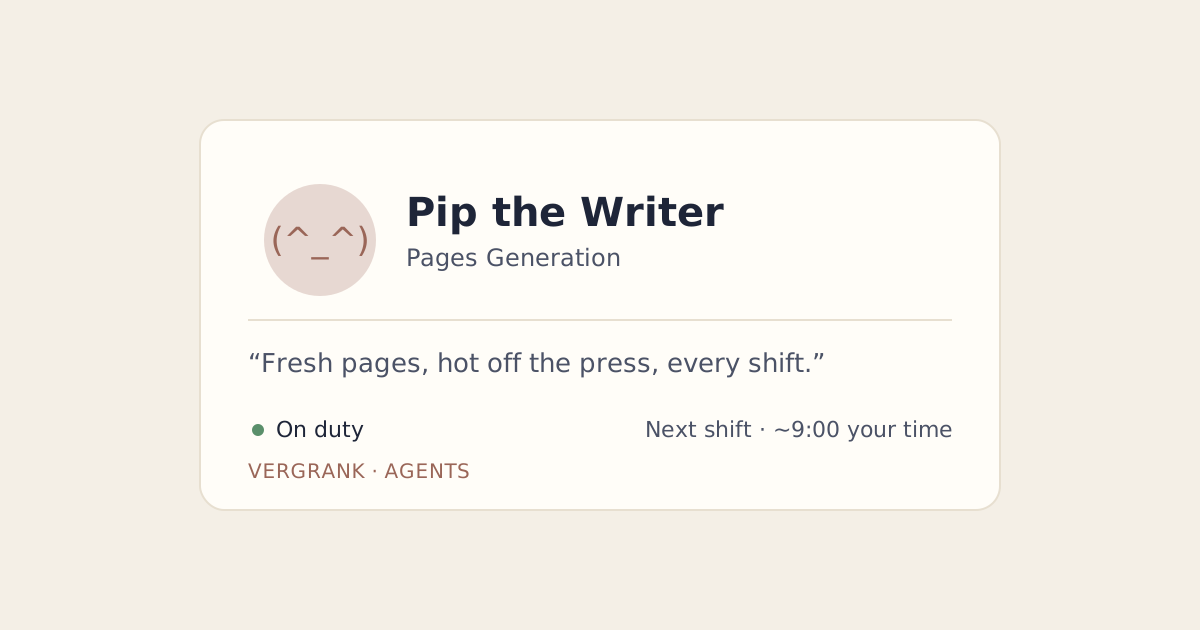
This is the first in a series introducing the agents that work your account around the clock. We’re starting with Pip because it’s the one whose output you can see most directly: the pages.
What Pip actually does each shift
Pip runs on your plan’s cadence — weekly on Starter, daily on Scale — and clocks in around 9:00 in your timezone, not ours. When the shift starts, Pip doesn’t just pick a topic at random. It scans your idle keywords and ranks them by three things at once:
- Priority — how important the keyword is to your business.
- AI invisibility — how little the AI engines currently mention you for it. The bigger the gap, the higher the opportunity.
- Competitor pressure — whether rivals are already getting cited for it.
The keyword at the top of that list is the one Pip writes next. So the first page of the day is, by design, the one most likely to move your AI visibility.
The pipeline behind one page
A single Pip page isn’t one prompt to a language model. It’s an assembly line, and every station has a job:
- Research. Pip pulls live search results and competitor facts so the page is grounded in what’s actually true today, not what a model guessed.
- Outline. It structures those facts into sections — each with an angle, the key claim it has to land, and a target length. It also generates a fan-out query layer: the 8–12 related questions an AI engine would ask around this topic, so the page answers them too.
- Draft. Pip writes the prose section by section and attaches the first layer of structured data — an Article schema block AI engines can read.
- Fact-check. Every claim is checked back against the research. A page that can’t support its claims doesn’t ship.
- Voice polish. Pip rewrites anything that drifts from your brand voice, so the page reads like you wrote it.
- SEO + GEO pass. This is where the page becomes genuinely citable: the schema is expanded to a full set — Article, BreadcrumbList, FAQPage, and a Product block for each competitor it compares you against — heading hierarchy is enforced, and the title and meta description are trimmed to the lengths search engines actually display.
- Internal linking. Pip wires the new page into your existing ones with a real citation graph, spreading ranking signal instead of leaving the page stranded.
Only after all of that does the page get published to your domain — where the template adds the rest of the machine-readable layer: canonical URL, Open Graph tags, an Organization block, robots directives, and your site’s llms.txt and sitemap, all automatically.
Why the structure matters more than the words
AI answer engines don’t cite good writing — they cite self-contained, factual passages they can lift accurately. That’s the whole reason Pip’s pipeline looks the way it does:
- Leading each section with a direct, quotable answer gives the engine a clean passage to pull.
- The FAQPage and Article JSON-LD make the page’s facts machine-readable, so a model doesn’t have to infer them from prose.
- The fan-out query layer means that when someone asks a related question, your page already covers it — which is how one page earns citations across a cluster of prompts.
This is generative engine optimization (GEO), and it’s a different discipline from classic SEO. If you want the full picture of how the two differ, our homepage breaks it down — but the short version is that Pip optimizes for both on every page it writes.
Pip never ships a bad page
The part clients tell us they trust most: Pip would rather publish nothing than publish something weak. Several gates can stop a page cold and route it to human review instead of your live site:
- Truth gate — if your product facts, competitors, or brand-voice samples are missing or stale, Pip won’t even start the run. No guessing.
- Fact-check — claims that don’t hold up against the research send the page to review.
- Tell-detector — a page that reads as obviously AI-generated gets flagged before it can embarrass you.
- Dedup — if the page is too similar to one you already have, it’s held back rather than diluting your site.
A page that trips any of these is marked needs review and stays off your domain until it’s approved. Everything that goes live cleared the bar.
Where to see Pip at work
Pip the Writer lives on the Agents page in your Vergrank portal, alongside the rest of your squad — Nora the Gardener (who refreshes pages as they age), Radar (rank tracking), Magpie (keyword discovery), and more. Each card shows the teammate’s job and next shift. The pages Pip produces show up under Your Content → Pages, where you can read, edit, or flag any of them.
We’ll introduce the rest of the squad in upcoming posts. Pip just happens to be the one whose work ends up on your site with your name on it.
Frequently asked questions
The FAQ above answers the most common questions about Pip — what it does, how often it publishes, whether it ships without approval, and what makes its pages citable. If you’re evaluating whether automated page generation can actually earn AI citations rather than just adding pages, the gates section above is the part worth re-reading: the value isn’t volume, it’s that every page is built and checked to be the one an AI engine cites.